

Job rotation: New perspectives and stronger collaboration
Sebastian Vögele from the Systems Engineering Division in Bern worked at the Competence Centre Artificial Intelligence and Simulation (AISI) in Thun from February to April 2026 as part of a job rotation; both divisions are part of armasuisse Science and Technology. In this interview, he talks about his work and the benefits of this development initiative.
Interview with Sebastian Vögele, Systems Engineering Division, conducted by Anela Ziko, Staff, armasuisse Science and Technology
What made you decide to undertake a job rotation?
I prefer to learn from concrete real-life examples in my day-to-day work. That is why my line manager, Gregor von Rotz, and I considered the opportunities for ‘on-the-job’ learning – and the job rotation in particular – during my development review. As my regular work in the Systems Engineering Division has some technical overlaps with AISI’s research topics, we approached the Head of Division, Michael Rüegsegger, about the job rotation. Fortunately, AISI were also keen on this idea. And so the ball, or rather the job rotation, started rolling.
What were your tasks during the job rotation?
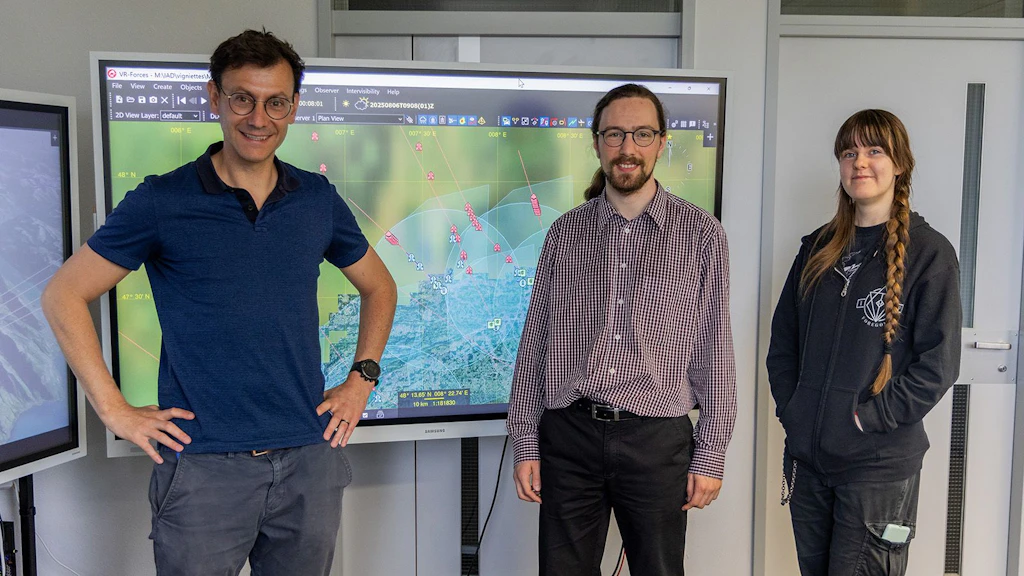
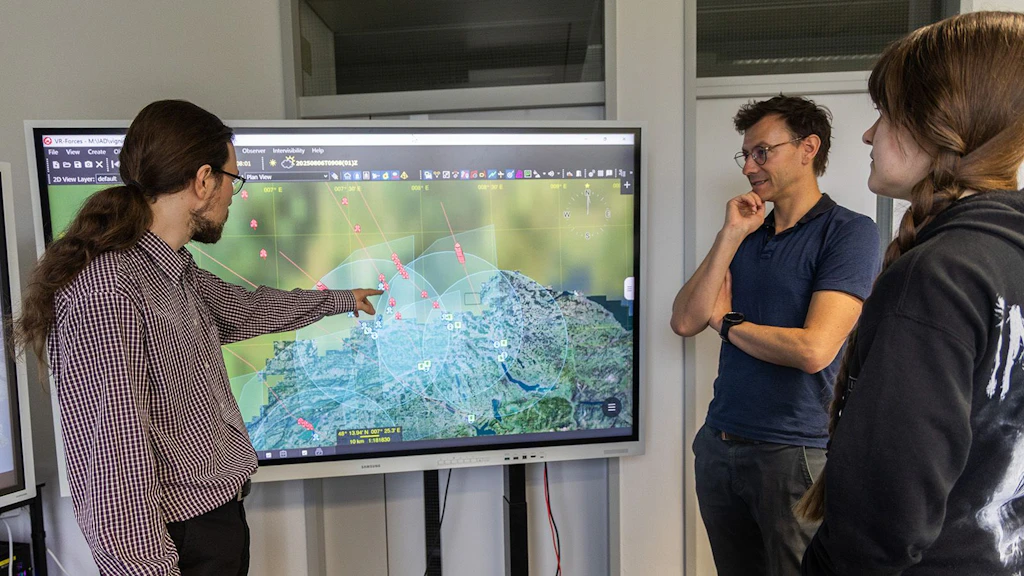
As part of the Virtual and Constructive Simulation Platform (VSP & KSP) projects, AISI is exploring the possibilities of a networked simulation environment. Within this networked environment, the Swiss Army’s various simulators can be interconnected and, in some cases, replaced.
I worked on a use case to simulate Switzerland’s future air defence. The aim was to refine the simulations, but also to identify limitations and areas for further improvement.
What added value does the job rotation offer?
The job rotation offered me an interesting and rewarding insight into a new subject area. Much like a university internship, I was able to tackle new tasks with relatively little commitment and for a clearly defined period of time.
Furthermore, I was able to get to know AISI better and contribute to greater exchange between the two divisions. This exchange is of mutual interest, particularly with regard to the potential translation of research projects into procurement.
For the ‘host division’, the job rotation also offers an opportunity to gain a new perspective on their areas of work.
What is required for a successful job rotation?
In addition to the motivation to familiarise oneself with a new field, solid planning is essential. The home division must manage with one fewer staff member for the duration of the job rotation and plan the work accordingly. The host division must prepare the tasks for the job rotation, provide the rotator with an introduction to the work and support them during the exchange. In my case, this was done by Adrian Schneider. He took the time to introduce me both to the project and to the working methods of AISI.
Once this is in place, job rotation can be carried out very pragmatically with minimal administrative effort. For me, the job rotation was well worth it and I would do it again!
In just a few weeks, Sebastian developed a large-scale simulation for ground-based air defence. The job rotation is a success. We would love to keep Sebastian on straight away.
Senior Research Project Manager / Deputy Head of the AI and Simulation Center
It’s great to see that something of great and lasting value has been created in such a short time and that it has benefited everyone. The job rotation has also had a positive impact on both divisions and brought them closer together. And no, we’re not letting Sebastian go, but the collaboration will certainly continue.
Head of the Division Systems Engineering
What is a job rotation?
In a job rotation, employees take on a different role for a limited time (usually 3–12 months) to gain insights into the scope of that role. A job rotation can be a mutual swap of two people or one-sided.
Further information
The Competence Centre Artificial Intelligence and Simulation