

INSIGNE – Modernisation of electronic warfare
Within the INSIGNE project, armasuisse Science and Technology (S+T) supports the planning as well as overall management and is responsible, amongst other things, for the subproject “New skills”. The goal is to modernise electronic warfare in the Swiss Armed Forces. The focus of INSIGNE is on the procurement of interoperable and modular systems.
Aldo Gamboni, specialist area Sensors, competence sector Procurement
Dr Denis Sallin and Cyril Etter, Communication and Electromagnetic Protection
Leandra Kolb, staff, armasuisse Science and Technology
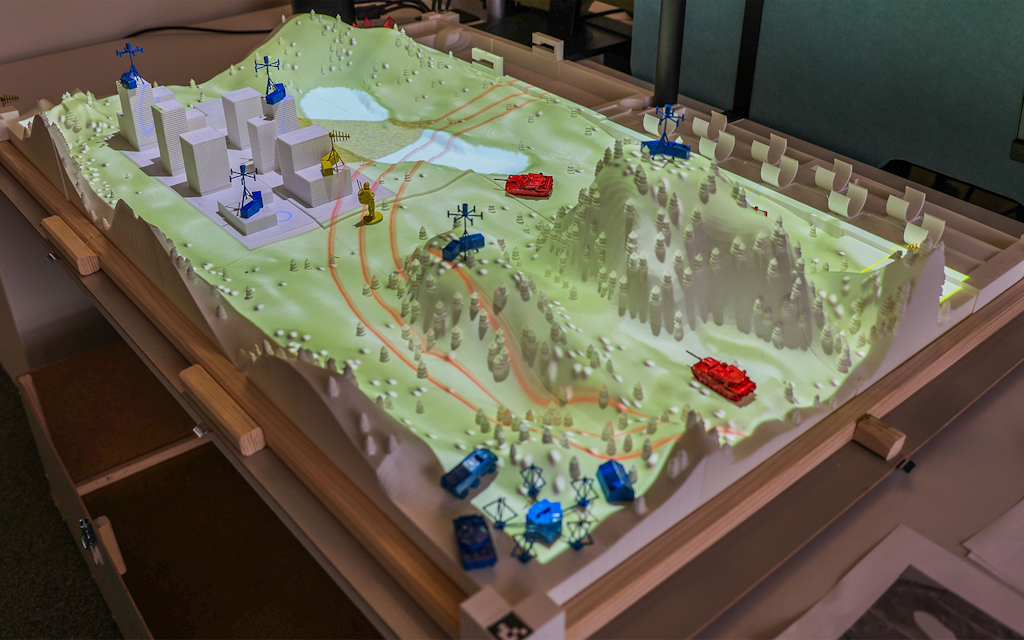
In brief
armasuisse Science and Technology (S+T) is managing the technical implementation of the INSIGNE project. The project will contribute to modernising electronic warfare (EW) in the Swiss Armed Forces. It will ensure that the Armed Forces have contemporary skills for electronic reconnaissance, interference and deception. In addition to the procurement of simple, modular and interoperable systems, the focus is on their integration in the existing system network . INSIGNE will establish the basic and additional skills to support tactical operations effectively, particularly in complex and urban environments. Both cooperation partners and industry will benefit from the knowledge gained.
On 5 November 2025, the Federal Council approved an arms cooperation in the area of Electromagnetic Warfare (EW) between Switzerland, the Netherlands, Germany and Denmark. This international agreement supports joint procurement and provides long-term support of modern systems of electronic warfare (EW). From 2026, sensor systems (Electronic Support, ES) as well as jammers (Electronic Attack, EA) will be procured together. These systems constitute a significant part of modern electronic warfare. On the one hand, the ES systems consist of a network of electromagnetic sensors for combat support, thus enabling opponent’s transmitters in electronic space to be detected, classified and localised. On the other hand, the EA systems create active interference against opponent’s sensors and communication systems. This is where the INSIGNE project comes in. Capacity building will be implemented in several stages as part of the 2026 armament programme.
Sensors and jammers play a decisive role in the impact of the entire system network and thus constitute a central component for increasing own enforceability and protectability in electromagnetic space.
Cross-DDPS cooperation
armasuisse Procurement is responsible for the overall project. Its area of responsibility falls under the procurement strategy, procedures and relationships between the Department of Defence, Civil Protection and Sport (DDPS) and external partners. armasuisse Science and Technology (S+T) on the other hand bears the technical responsibility for the INSIGNE project and manages the subproject “New skills”. This includes research, innovation and the testing of new characteristics and sensor types as well as the conceptual development for the future procurement steps of INSIGNE. Here, armasuisse S+T supports the Armed Forces Cyber Command (AFCC), the Land Forces, the Swiss Air Force (AF) and the Training and Education Command (TEC) in defining requirements based on experience already gained with the pilot system. The pilot system enables technical knowledge to be obtained with the system of the armament cooperation partners and to test the performance of the system in various configurations. INSIGNE implements the architecture of the pilot project on a large scale with systems that are adapted to the deployment concept. Through armasuisse S+T’s support, technical risks can be reduced and “Swissness” avoided. The goal is to procure the systems “off the shelf”. A system can thus be tested with the pilot system and the requirements on which the system options are based can be adjusted. This reduces costs and development risks. The Communication and Information System Labs (CISLabs) from armasuisse S+T function here as an integrated test envrionment for INSIGNE. As an information and communication technological (ICT) infrastructure, it enables operation of the EW pilot system.
The test infrastructure CISLabs as well as the close collaboration with armasuisse Procurement enabled the systems to be tested quickly and flexibly: Sensors in the network, interfaces to outside systems and identification of restrictions.
The pilot system implements the complete system – various different sensors, ES components in the network with interfaces to EA systems, communication systems (TkA) and command and control systems (IPLIS) – on a smaller scale and enables the agile and cooperative integration of sensors, jammers and C2 components with the industry and Armed Forces Cyber Command. This platform is also used in the system integration phases during procurement, to validate the requirements for modularity, scaleability and performance under diminished conditions.
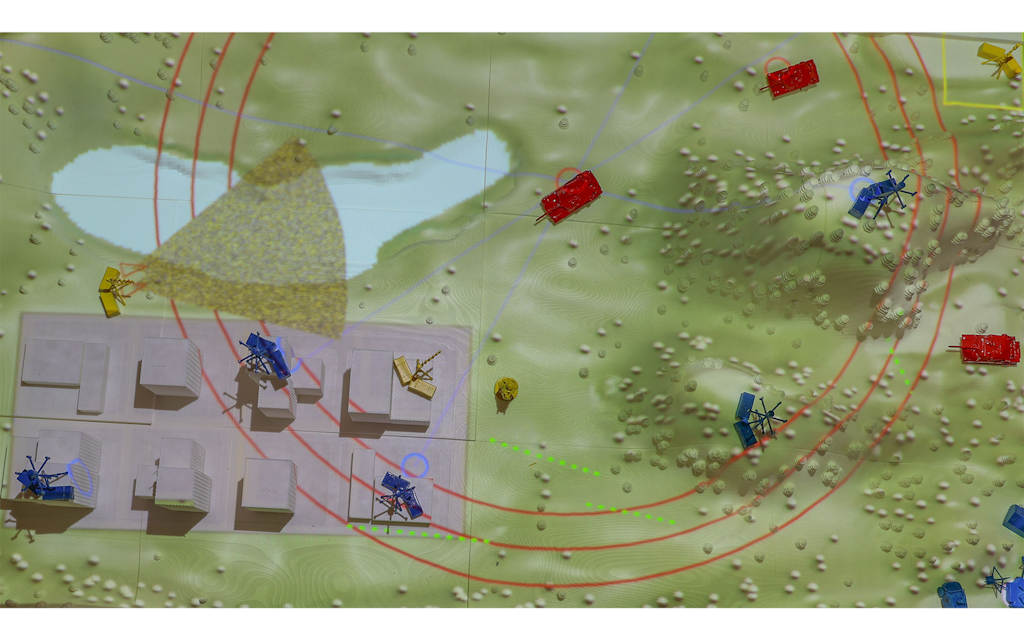
Photo caption
Red concentric circles: Propagation of electromagnetic waves, communication of opponents
Red tank: Resources of opponents
Yellow sector: Action of a jammer which disables an opponent’s communication
Blue bearing lines: Triangulation
Small red circle: Localisation of the opponent’s transmitter
Blue sensors: Electronic Support (ES) systems (direction finders)
Blue circles: Position of the ES systems
Yellow transmitters: Electronic Attack (EA) systems
INSIGNE is shown by the blue sensors (ES) and the yellow jammers (EA).
Outlook
armasuisse S+T deals with the continuation of the pilot system and performs further tests with the troops in cooperation with the AFCC. In addition, armasuisse Procurement, responsible for procuring the ES and EA systems as part of the 2026 armament programme, initiates the further steps for procuring the systems mentioned.