Focus on research: Programmes, projects and results – annual reporting of the research programmes “Reconnaissance and Surveillance” and “Communication”
On Tuesday, 25 March 2025 armasuisse Science and Technology (S+T) issued an invitation to the two annual reporting events of the research programmes “Reconnaissance and Surveillance” and “Communication”. The two research programme directors Dr Peter Wellig and Dr Christof Schüpbach offered internal employees at the DDPS exciting insights into current research activities, projects and results.
Moana Häfeli, Staff, armasuisse Science and Technology
In brief
The goal of the annual reporting events of armasuisse Science and Technology’s (S+T) research programmes is to grant interested internal employees at the DDPS a look behind the scenes of the research programmes. This framework not only offers broad insights into various different fields of work and ongoing projects, but also a useful opportunity for the open exchange of ideas. The event thus encourages the mutual exchange of knowledge and strengthens cooperation internally in the DDPS.
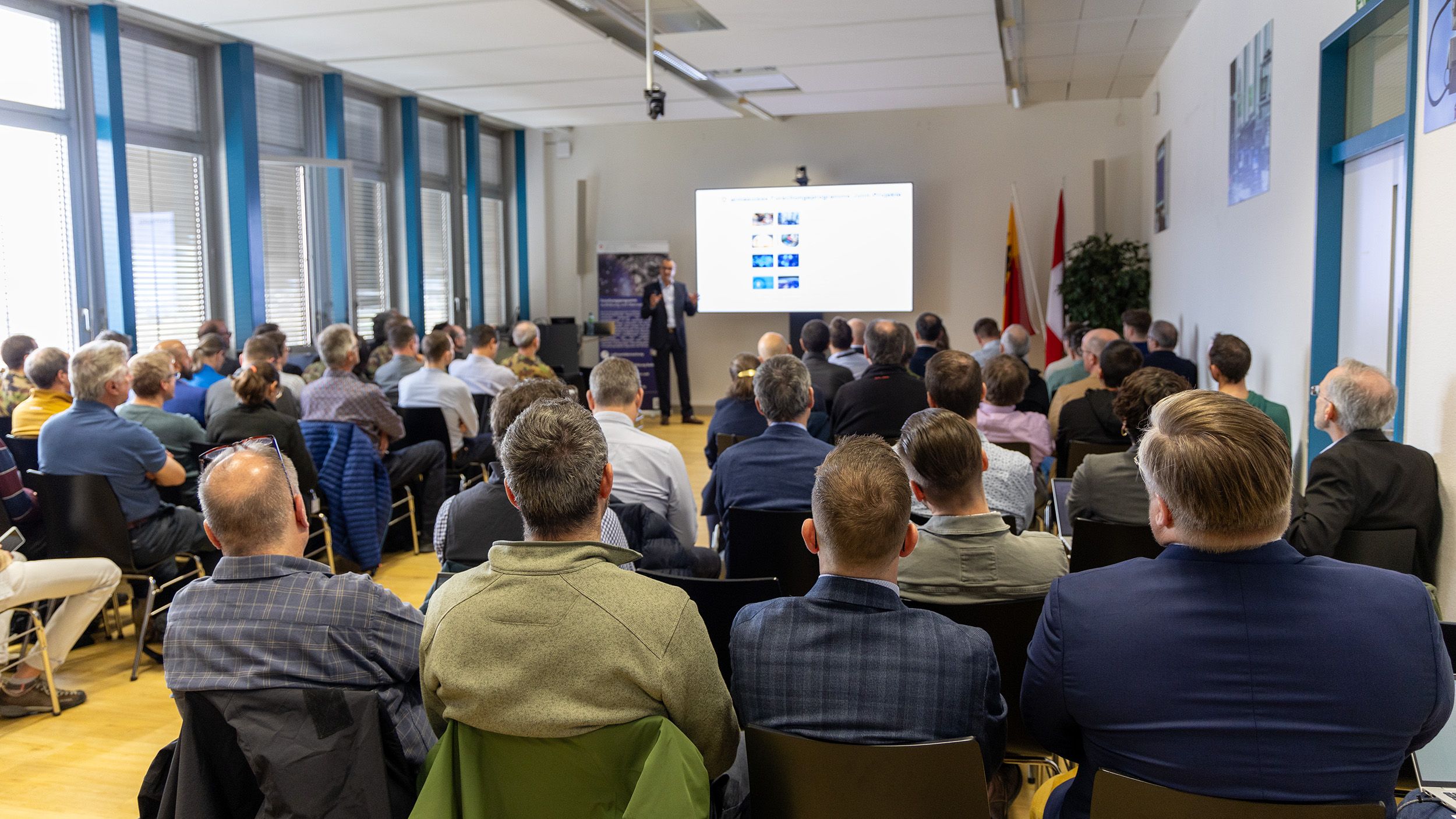
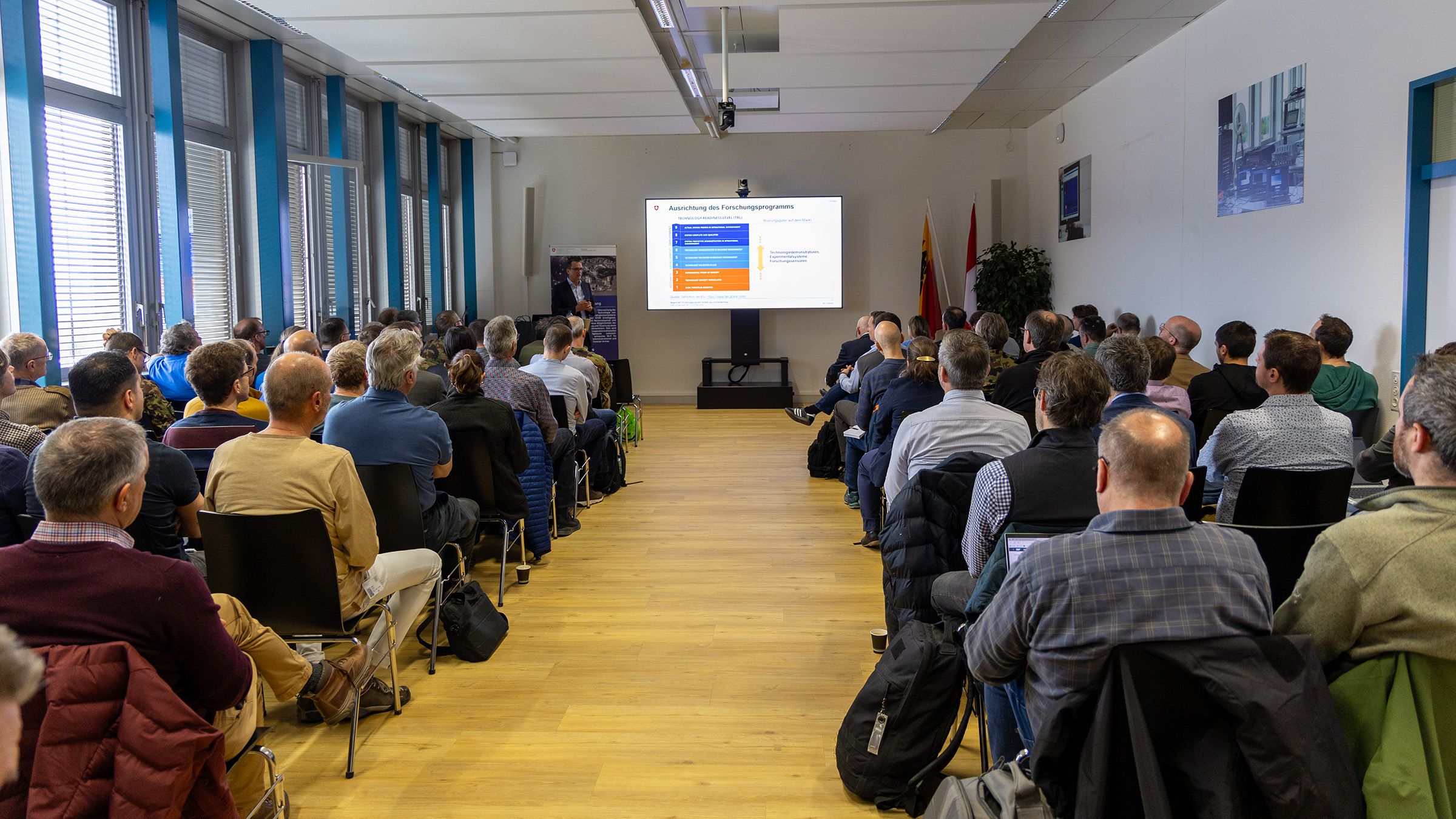
The annual year’s reporting event kicked off with the research programmes “Reconnaissance and Surveillance” as well as “Communication”. With around 140 participants, this year’s performance repeatedly met with great interest within the DDPS and amongst the internal employees.
Restructuring of the research programme “Reconnaissance and Surveillance”
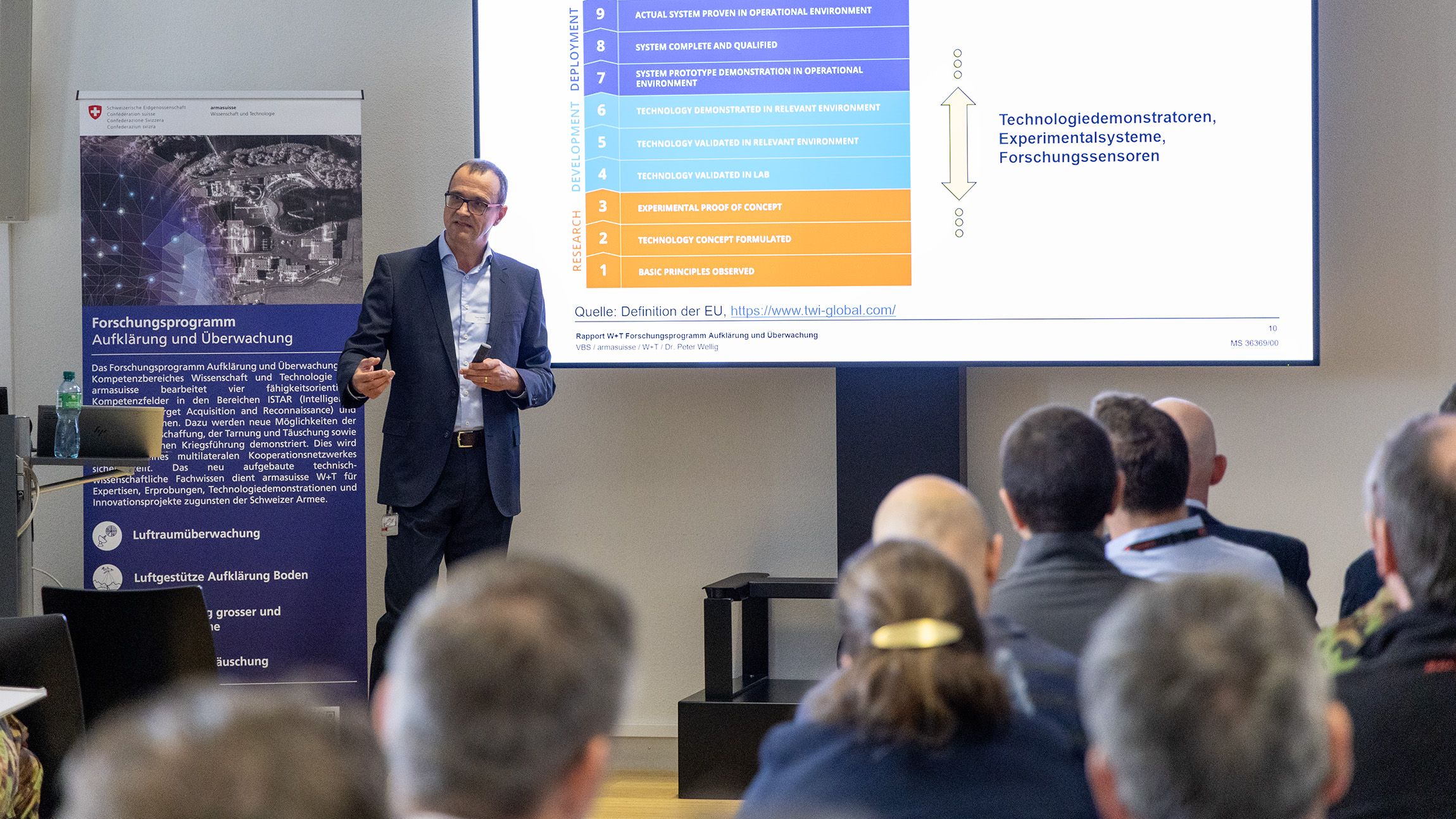
At the start of the first annual reporting, Dr Peter Wellig gave a brief overview of the research programme “Reconnaissance and Surveillance”. As part of this, Dr Peter Wellig presented the restructuring of the research programme. The research programme is now working on four capability-oriented fields of competence in the ISTAR areas (Intelligence, Surveillance, Target Acquisition and Reconnaissance) and countermeasures. The four fields of competence are divided up as follows: Air surveillance, airborne reconnaissance of ground targets, surveillance of large areas (including urban environments) as well as camouflage and deception. Dr Peter Wellig also emphasised that a broad spectrum of networks is key to ensuring the development of skills. This includes the close multilateral cooperation with NATO/PfP research partners, universities, higher education institutions, industry and internal joint research projects. The research programme director also provided information on some of the current research activities, such as the detection of small drones using various sensors in a challenging environment as part of the NATO exercise TIE’24.
This was followed by three technical presentations on the topic of “Combat reconnaissance and deception”. Andreas Zihlmann, scientific project manager in the area of sensory analysis informed the participants of the joint experiment as part of a NATO/PfP research campaign (Partnership for Peace), with various national and international research partners who tested the performance limits of drone-based radar systems. In a subsequent presentation, Dr Elias Mendez from the University of Zurich presented the systems of the University of Zurich tested there. Marc Radstake, group leader of Innovation at armasuisse S+T then completed the first block with a presentation on mock-ups and the signature optimisation of mock-ups.
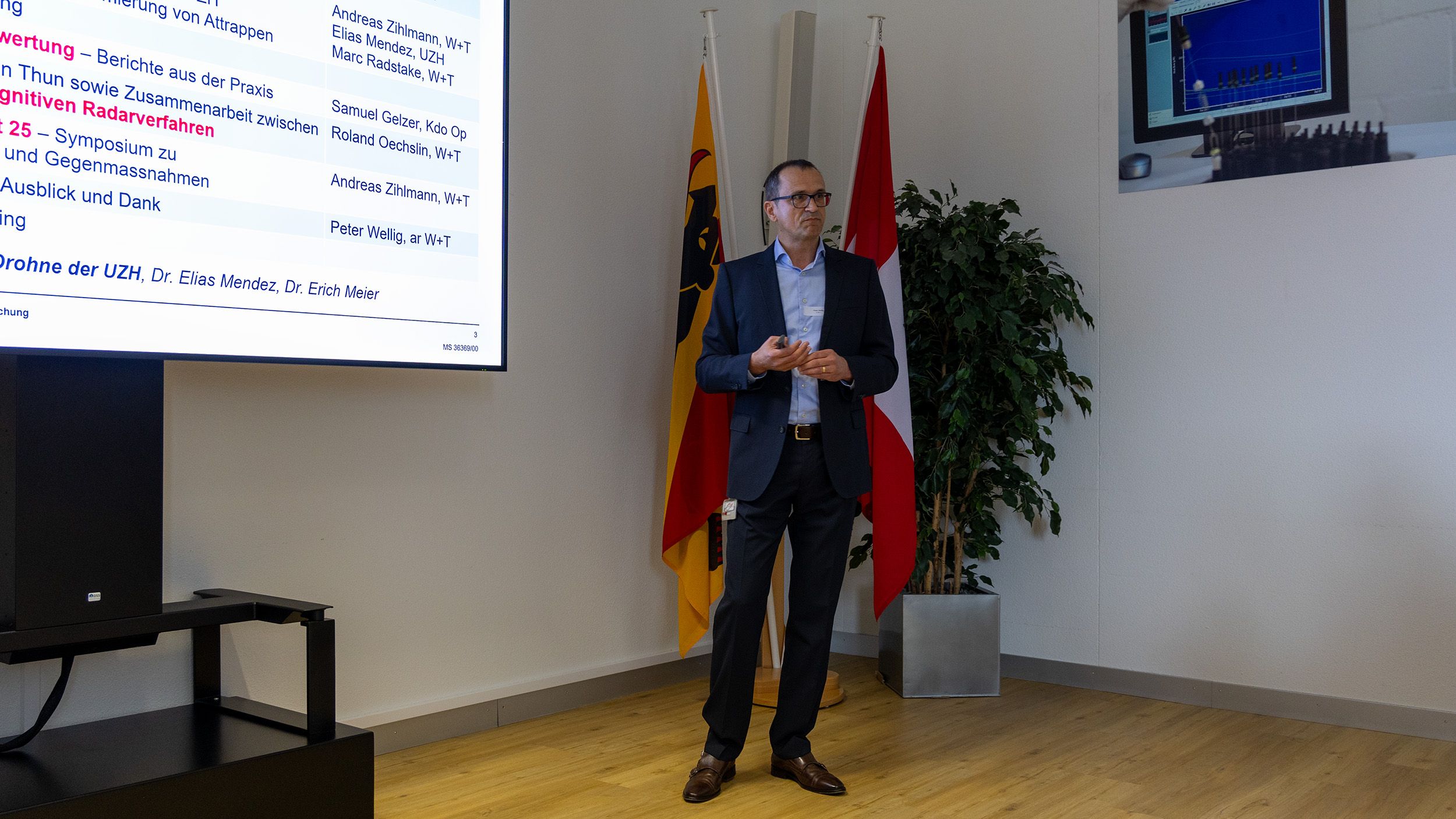
Samuel Gelzer from Joint Operations Command started the second block with a report on spatially-based imagery intelligence (IMINT). The practical explanations offered the listeners an exciting look behind the scenes and provided an overview of the diverse fields of activity of IMINT. Dr Roland Oechslin held a further presentation on the topic of “cognitive radar procedures”. The focus is on developing the cognitive radar system according to the model of human cognitive abilities. In this regard, Dr Roland Oechslin presented trials carried out in the NATO research work group SET-302, which were used to develop the cognitive radar systems. Project manager Andreas Zihlmann rounded off the first research report of the year with a brief insight into the ongoing event preparations for the symposium “Scout 25 – Modern battlefield reconnaissance and countermeasures”.
Finally, Dr Peter Wellig referred again briefly to the event “Scout 25 – Modern battlefield reconnaissance and countermeasures” taking place on 18 June in Thun, as well as other planned research activities of NATO/PfP and internal joint research projects.
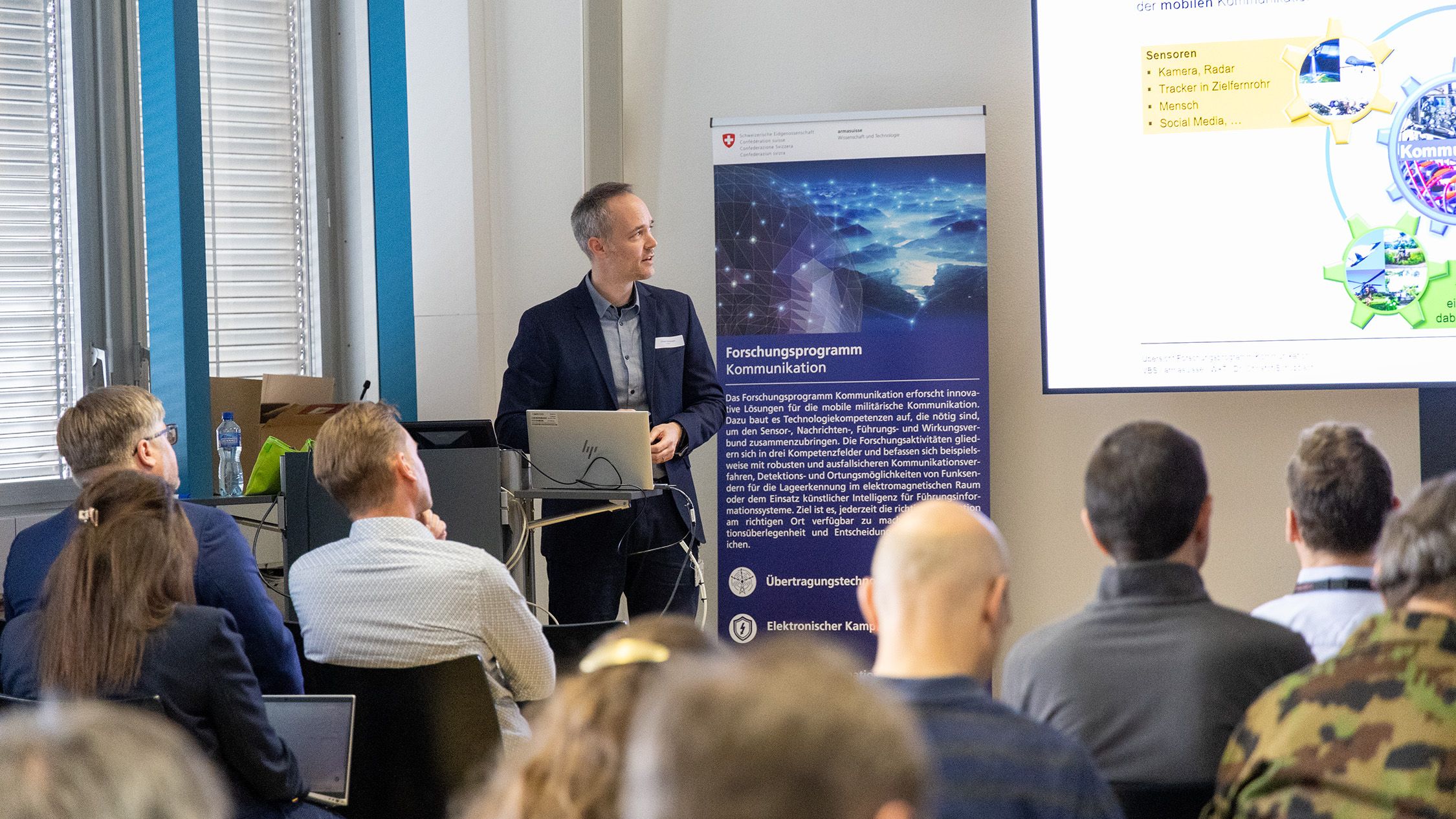
A steady development of skills in the research programme Communication
The afternoon was all about the second research programme “Communication”, headed by Dr Christof Schüpbach. As in the morning programme schedule, Dr Christof Schüpbach presented those present with the restructuring of the research programme, in addition to a general research programme overview. The research programme is now oriented to the following three fields of competence – transmission technologies, electronic warfare as well as command and control system technologies. In particular, the latter covers the project to ensure interaction between the command and control and communications systems, in order to successfully close the intelligence collection and tactical reconnaissance network (SNFW). In addition, the research programme director once again emphasised the importance of a broad partnership network to expand specialist expertise. Knowledge transfer between the project managers is particularly key here. “Competence is not transferred on a memory stick”, says Dr Christof Schüpbach. Mention was also made of various research activities such as photonics for radio applications. This includes technologies which generate and manipulate signals optically and can convert them into radio signals for transmission, which provides notable advantages, such as high bandwidths and flexible frequency selection.
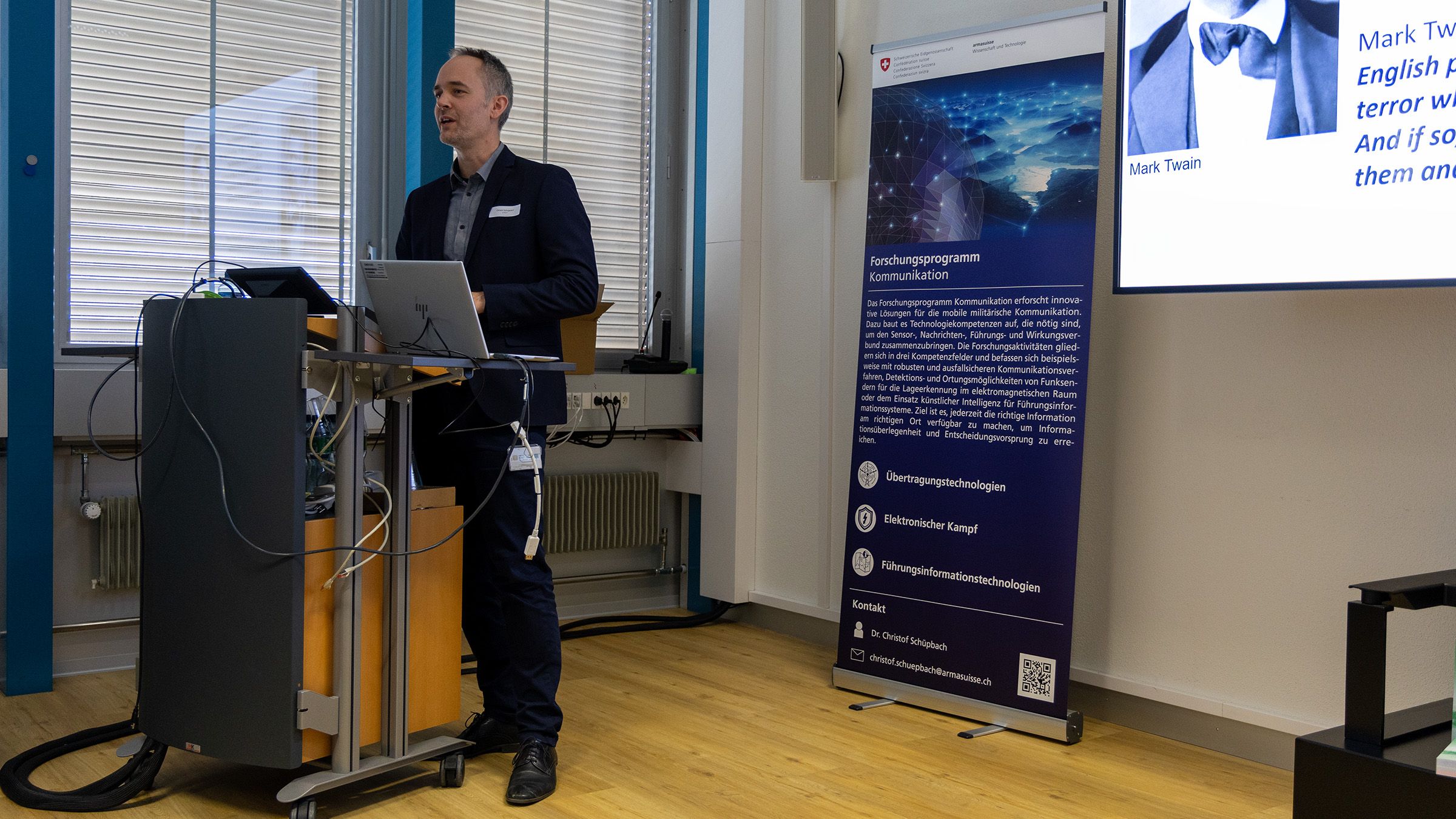
After the introduction to the research programme Communication, Dr Christof Schüpbach gave the floor to Col. Mietta Groeneveld, Director of the NATO Command and Control Centre of Excellence. Her technical presentation was dedicated in particular to the current challenges of NATO in the area of Command and Control and the strongest drivers behind these. In a further paper, Dr Meriem Elhosni, scientific project manager in the area of Communications and electromagnetic protection, presented the research project C2SIM (Command and Control Simulation). The goal is to deploy and network artificial intelligence (AI) for the realistic generation of simulated scenarios as well as to support training and decision guidance in operations. In addition to this, Dr Meriem Elhosni, together with Dr Matthias Sommer, scientific project manager in the area of Artificial Intelligence and Simulation, explained how the systems of the research project C2SIM, C2 systems as well as the simulation at this year’s NATO exercise CWIX (Coalition Warrior Interoperability eXploration, eXperimentation, eXamination eXercise) 2025 are tested.
Dr Raphael Rolny completed the day and the research report with a presentation on the topic of “Interference-free communication in electromagnetic space”. He emphasised here that military communications systems in particular are being increasingly confronted with challenges. This poses the question of how these communications systems can be made more efficient and robust. Based on three research projects, Dr Raphael Rolny outlined the initial findings and possible solutions for inference reduction in military communications systems. The procedures examined represent considerable potential for the Armed Forces, as the military communications systems could thus transmit, receive and jam simultaneously, while jamming signals from adversaries can be suppressed.
Conclusion and outlook
At this point, armasuisse S+T took the opportunity to thank all the speakers on behalf of all participants as well as for the lively interest and valuable, open, exchange of ideas.