

How Swiss robotics is tested and transferred to the Armed Forces
The protection and security of task forces can be increased by deploying robots. The robots increase the effectiveness and efficiency of missions. This is because they can grasp certain information much more quickly, do not tire and can penetrate places which are unattainable or life-threatening for persons. The Swiss Drone and Robotics Centre plays an important role here, as it tests emergency cases using robots. This article explains how deployment scenarios are tested, how artificial intelligence makes the robots more reliable and autonomous and how the robots are transferred to the Swiss Armed Forces.
Dr. Tonya Müller, Swiss Drone and Robotics Centre of the DDPS, armasuisse Science and Technology
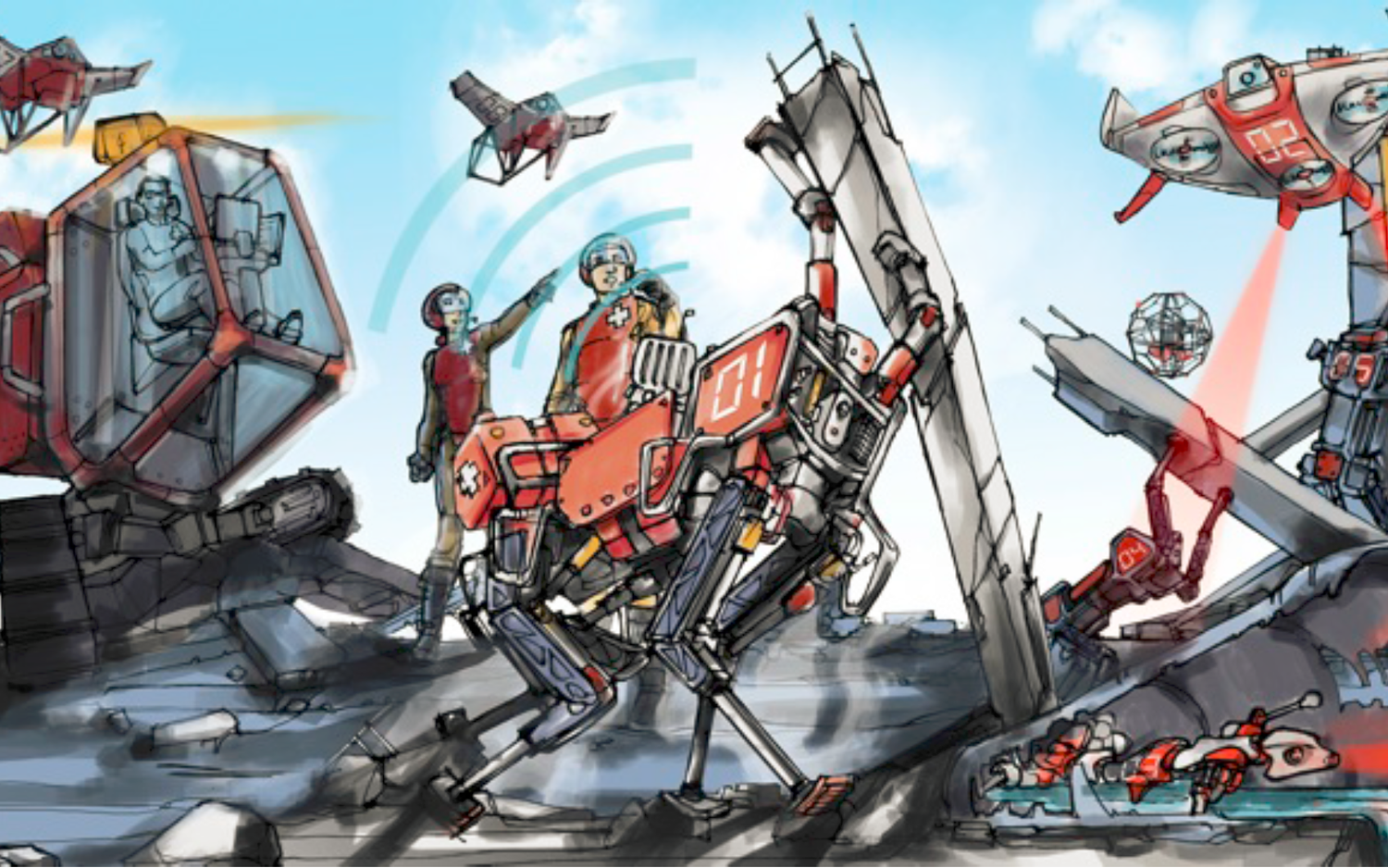
The Swiss Drone and Robotics Centre SDRC examines how it can provide technical support to the Swiss Armed Forces as well as other security bodies in threatening situations. To this end, it conducts research to assess the state of technologies as well as possible applications for the Armed Forces.
The robot R2-D2 from the Star Wars saga will be familiar to many people. This intelligent robot with the semicircular head navigates, recognises dangers and, as an «all-purpose tool», saves his friends Luke Skywalker and Princess Leia from threatening situations. The Swiss Drone and Robotics Centre (SDRC) does not deal with technology for intergalactic tasks. However, it does deal with technologies which could serve as intelligent all-purpose tools to provide technical support to the troops of the Swiss Armed Forces and other state security bodies in threatening situations.
How remote-controlled building machinery performs tasks in risk regions
The Swiss Armed Forces often uses pitfalls for its target practices. Spent ammunition and parts of ammunition, as well as unexploded ordnances, pile up inside these pits. Numerous such pitfalls as well as large-scale shooting ranges now need to be cleared of ammunition residue. The walking excavator ARMANO is designed for precisely these tasks with dangerous, contaminated heavy loads. This remote-controlled excavator can clear not only pitfalls, but also chemical and radioactive material. Instead of risky and time-consuming clearing by human hand, task forces could localise and recover the many tons of material from a safe distance thanks to ARMANO. The excavator can now also be attached to a suction machine. This enables contaminated material to be carried away considerably more quickly. In order to test the skills and reliability of ARMANO for real deployment in the Armed Forces, the machine operators from the training unit Engineer/Rescue/NBC (LVBGRABC) have carried out several tests with the Centre of Competence for removing unexploded ordnance and demining (NBC EOD CC), with Protection and Rescue Zurich (SRZ) and with the Swiss Federal Railways (SBB). The machine operators were able – from a distance of up to several hundred kilometres – to remotely control the ARMANO in areas at risk of explosion, collapse and avalanches. Thanks to numerous cameras and sensors on the excavator, these surroundings are displayed on four large screens in real time in the remote control cockpit. All camera images also show virtual elements in the form of coloured areas and dots. This augmented reality aims to improve spatial depth perception and orientation for the machine operator, as these are restricted due to remote control. The tests were successful, which is why ARMANO as well as another even more powerful remote-controlled crawler excavator was transferred to the LCBGRABC at the end of 2021.
Robots are generally transferred to the Swiss Armed Forces as part of ARDET. ARDET stands for Advanced Robotic Detachment and denotes a process developed jointly by the SDRC and the LVBGRABC. Using this process, robots can be transferred and deployed to the Armed Forces even with a lower level of technical maturity. The advantages are numerous. Researchers can thus continuously adapt the robots to the needs of the consumer. In addition, the Armed Forces can keep up with rapid technological change, and can obtain experience in the areas of training, finances, security and required staff, even before procurement.
How the walking robot creates an operational picture completely autonomously
Let’s talk now about an example of deployment for a robot in a closed building complex. A large number of laboratories work with chemical and radioactive components. In the event of an explosion, chemicals could leak out, the air could become toxic and radioactive components could lie around exposed. In this type of scenario, task forces want to be able to create an operational picture as quickly and accurately as possible and to find people. The SDRC’s four-legged robot ANYmal can be sent completely autonomously into the danger zone in such fields of operation. In contrast to other robots with tracks or wheels, the walking robot can overcome gaps and obstacles, climb up stairs and straighten up again after a fall. Thanks to its remote-controlled arm, it can also grasp objects, operate switches and open doors. In addition, it can identify hazardous substances from a safe distance using a detector. The ANYmal can explore the danger area independently for up to three hours before it needs to be recharged. During this time, it creates a map of the event perimeter in real time, localises itself in this map, identifies sources of danger, locates people and records their positions. Recently, the ANYmal’s feet have been replaced with wheels. Thanks to this combination of wheels and legs, the robot retains the advantages of walking while attaining speeds of up to sixty kilometres an hour and thus progresses significantly faster and with more energy efficiency. This diversity, agility and autonomy of ANYmal led the research partners in 2021 to victory in the internationally most challenging robotics competition, the Subterranean Challenge of the Defence Advanced Research Projects Agency (DARPA) of the US Department of Defense.
The ANYmal originates from the same Swiss research group as the remote-controlled building machinery. This enables findings in the use of artificial intelligence (AI) to be transferred between the systems. The AI is fundamental to developing the capacities and in particular also the autonomy of these robots. It is used in two different ways here: First of all, the AI refines the regulation and control systems for increasingly complex missions and operational areas. Secondly, it captures and compresses the AI sensor data for user-optimised display.
How diving robots perform reconnaissance under water
Let’s turn now from land robots to a robot that provides support under water. Hundreds of missions take place in Swiss waters every year to recover objects and to monitor places at which ammunition has sunk in the past. Special forces spend hours in deep, cold waters for this purpose and are potentially also exposed to chemical and explosive risks. To support these kinds of tasks, the diving robot by the name of Proteus now comes into play. Its deployment increases safety, as it can examine an area contaminated with ammunition from a distance. The robot thus supplies a digital database which can be exchanged with other task forces such as the police, in order to be able to plan a strategy when dealing with the dangerous goods.
So what exactly does Proteus look like? It has a rectangular body and is equipped with two propeller motors at each corner. This makes it exceptionally manoeuvrable. The robot has a gripper arm and transmits a camera image as well as a sonar image in real time. The sonar image displays the surface structure of the surrounding objects, even in poor visibility conditions. It can dive up to 600 metres and can provide help for up to four hours despite the cold temperatures. Research is currently being carried on how the robot can localise itself using underwater GPS, in order to autonomously scan and map a danger area. In addition to ARMANO and ANYmal, Proteus has also been continuously tested and evaluated in close exchange with the emergency services of the Swiss Armed Forces. After only two years, it was functioning so reliably that it was also transferred to the EOD divers as part of ARDET.
Based on its knowledge of Proteus, the research partner of the SDRC is working on a new robot for deployment in running waters. This aims to enable reconnaissance under conditions or at operational locations which pose too high a risk for the military divers. The river robot could be used, for example, with higher speeds of water flow, where there is a risk of floating debris, or in areas above dams and hydropower plants.
How modular drones and robots could be used in combination
All the robots presented above have different skills and characteristics. But how can their operation be standardised and how can they cooperate to create added value together? One project goal is to combine the specific skills of individual robots such that they can record an operational picture, perform reconnaissance and provide communications support, monitoring and inspection as quickly, completely and reliably as possible. In order to evaluate this potential, the SDRC is researching a standard together with a Swiss company. Based on this standard, the aim is to control and localise the robots via the same user interface. In addition, it is planned for the robots to transfer their measurement data via the same interface. Such a standard would offer major advantages for the task forces: The standardisation of operation and data reduces the training time and simplifies the operational processes.
The examples mentioned show how the expertise of the Swiss robotics industry and the research landscape is being used for national security. The SDRC aims to research solutions in the area of transport concepts, navigation, man-machine interfaces and key technologies, which the task forces can use willingly and effectively. The process ARDET has been initiated with the transfer of individual robots to the Swiss Armed Forces. This process now needs to be structured and consolidated such that this rapidly developing technology can be transferred to the task forces even more efficiently in the future. Although the robots mentioned here are far from being able to interact seamlessly with persons as R2-D2 does, the cooperation between humans and machines can already serve to manage dangerous situations more efficiently today and to increase protection and safety.