Remote-controlled excavator in action: An example of successful collaboration
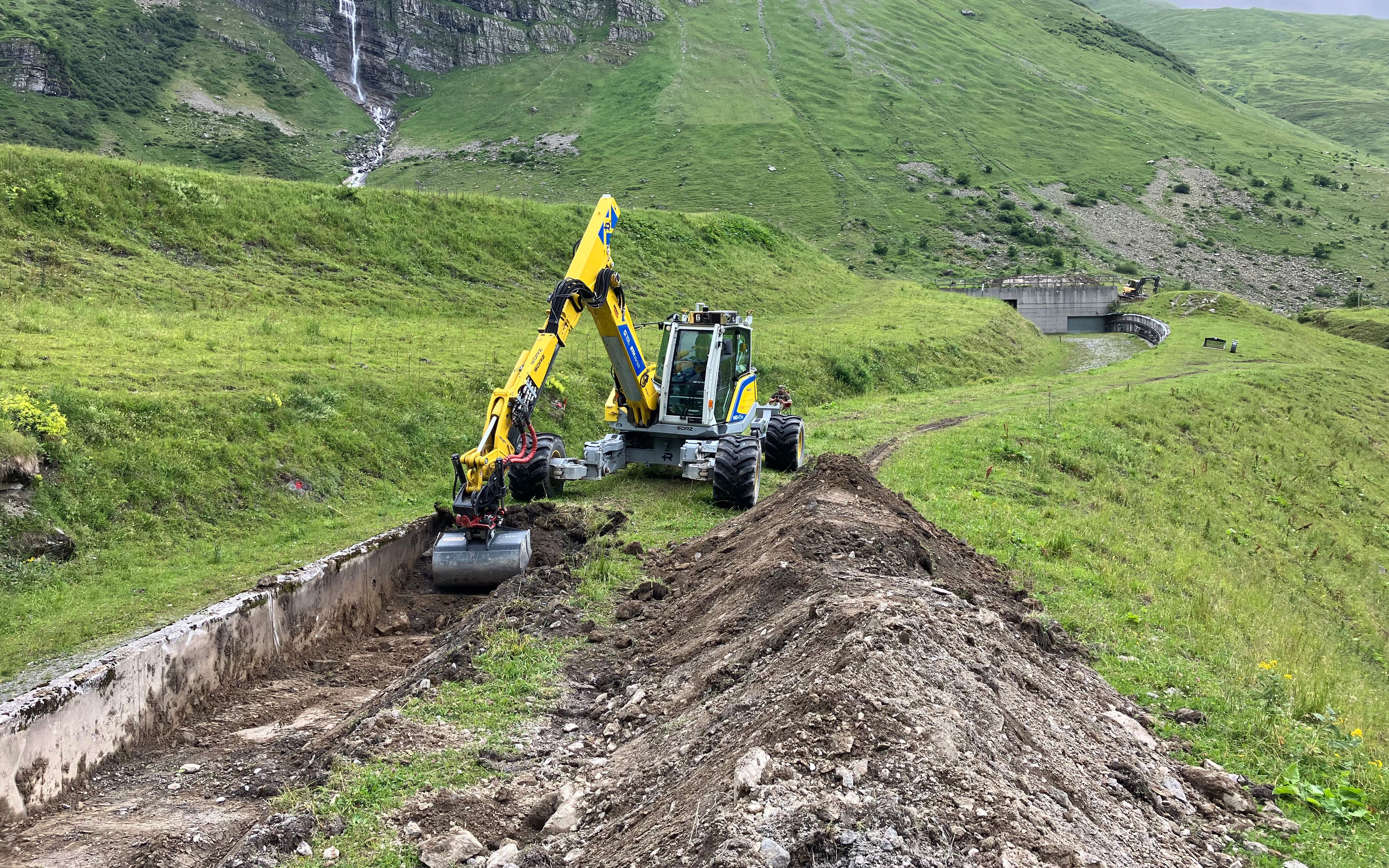
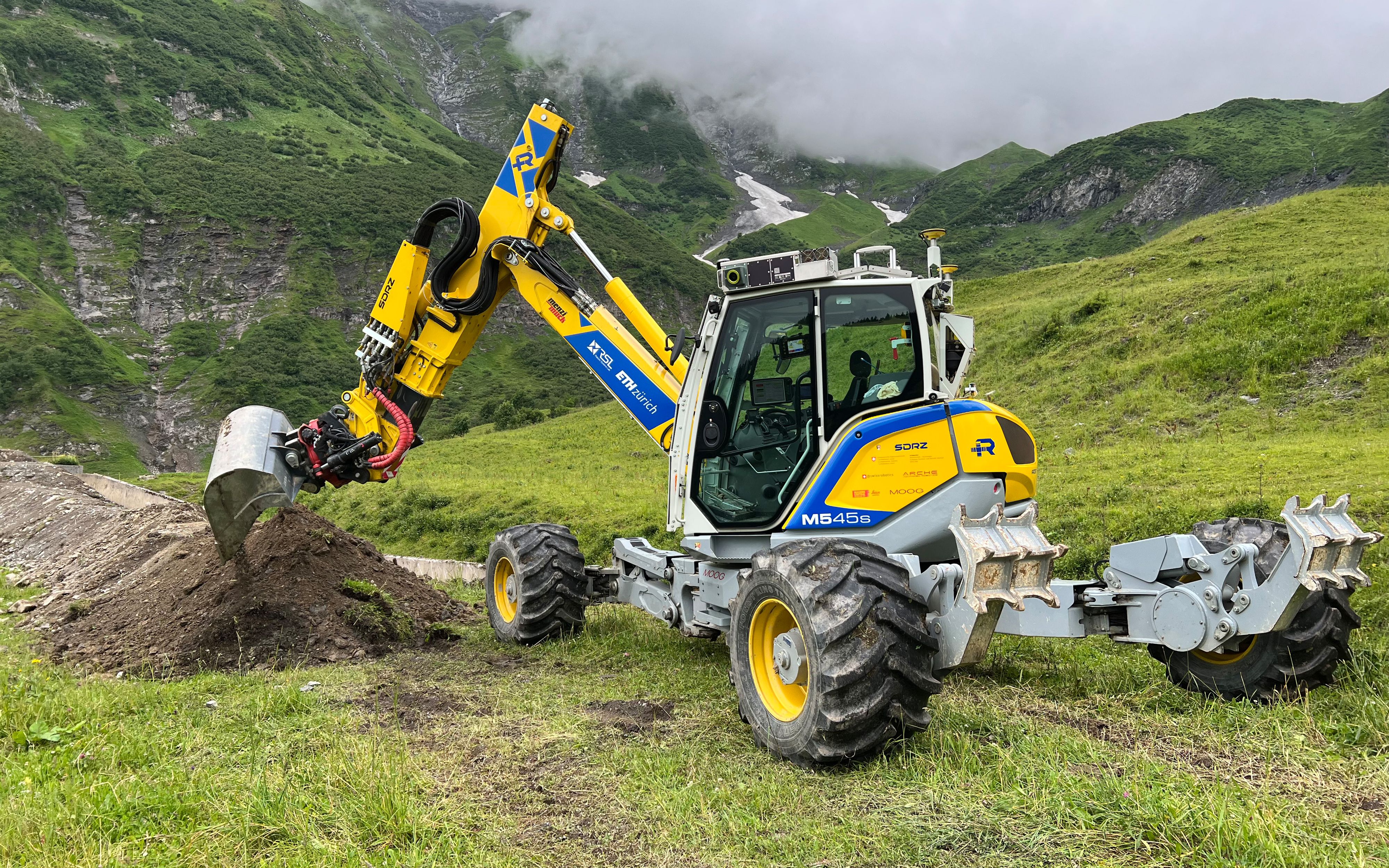
The supporting walls of the tank target line had to be restored on the Wichlen shooting range. For this purpose, armasuisse carried out an assignment with the Engineer/Rescue/NBC Training Unit (LVb G/Rttg/ABC) in July and October 2023. Single-term conscripts from the Engineer/Rescue/NBC Training Unit Command were able to successfully perform restoration work with the unmanned, remote-controlled walking excavator known as «Armano». An interview with three persons who were involved.
Interview with:
Dr Tonya Müller, scientific project manager, armasuisse Science and Technology;
Daniel Hafner, project manager and client, armasuisse Real Estate;
Daniel Sommer, head of specialist area Training and Operations Centre Crane Vehicles, dis rl sb bn
In the following interview, the project managers from armasuisse Real Estate, Engineer/Rescue/NBC Training Unit and armasuisse Science and Technology (S+T) provide insights into the organisation and implementation.
How did you come to be involved in the operation on the shooting range?
Daniel Hafner: As project manager for the Wichlen shooting range, I am the responsible party for ensuring that costs and deadlines are met. We from armasuisse Real Estate commissioned the Explosive Ordnance Disposal and Mine Action Command (EOD Command) to carry out unexploded ordnance clearing on two construction sites. EOD Command knew about the need for training options for the remote-controlled walking excavator «ARMANO».
Based on the internal contacts between armasuisse Real Estate, armasuisse Science and Technology and the Engineer/Rescue/NBC Training Unit, the support services of the Armed Forces for construction machinery work on the Wichlen shooting range was approved by a service level agreement.
Tonya Müller: The EOD Command had already familiarised itself with the walking excavator «ARMANO» before the assignment on the Wichlen shooting range in various tests. Due to the possible risks posed by unexploded ordnance during restoration work, the EOD Command enquired about the remote-controlled operation of walking excavators at the Swiss Drone and Robotics Centre (SDRC), which is domiciled at armasuisse S+T. After a joint inspection and the assessment by head of operations Daniel Sommer and project manager Daniel Hafner, the remote-controlled excavator could be put into operation following the declaration of clearance from the Contractors’ Association of the canton of Glarus.
Daniel Sommer: Due to the Armed Forces Act, under which the Armed Forces may not compete with industrial providers, the respective papers and requirements had to be submitted and complied with by the applicant. This was to ensure compliance with and fulfilment of the legal basis. This process was concluded quickly and in a straightforward manner, with a positive result. Now nothing more stood in the way of the assignment.
Who operated the excavator?
DS: The machine was operated by single-term conscripts of the disaster relief standby battalion (dis rl sb bn). These are soldiers who complete their entire 300 service days in one go and do not need to take any more refresher courses afterwards.
The single-term conscripts receive their basic training on the construction machinery of the engineer corps and rescue troops in the recruit school. They will only be trained on the robotic machine and prepared for possible operations when they change over to the dis rl sb bn later on.
In order to guarantee a certain overlap between the new and old single-term conscripts and thus permanent assurance of the availability of the robotic construction machines, the changeover to dis rl sb bn will take place early on.
The soldiers are very interested in the new technology and the options that this offers. The walking excavator is still the king among construction machines.
How was the training organised?
DS: In the dis rl sb bn, the Training and Operations Centre Crane Vehicles train the single-term conscripts on the specific and robotic construction machines and thus prepare them for possible operations. The training is carried out by military professionals in small groups.
Why is that? The dis rl sb bn is the first port of call when an incident occurs. If an incident does occur, there is no time to make our soldiers fit for the operation. We must always be ready to be able to perform our services. The training is therefore very intensive and much is demanded from the soldiers, but also of course from the military professionals.
What was important during this operation?
DS: The first steps before the actual work were ramping up the resources and testing the security aspects.
TM: The SDRC was on location three times altogether during the operation, to exchange ideas with those involved. We wanted to use this rare opportunity to find out as much as possible about a real deployment with the walking excavator: How does the remote-controlled machine work? What is missing? How does the machine behave in a challenging terrain? And much more. With the answers to these questions, gaps in the expertise of «ARMANO» can be closed by more targeted measures.
Was any unexploded ordnance found?
DS: Live unexploded ordnance was not found. Only parts that do not present any hazards were found. These were disposed of in accordance with regulations.
What were your experiences and findings?
TM: From a technical perspective, we were able to further optimise ease of operation and data transmission. The installation and awareness during operation requires a period of familiarisation but can then be categorised as intuitive and straightforward. This assignment expanded our understanding of remote-controlled technology and provided important insights with regard to training and deployment concepts. This ultimately enables us to better assess the framework conditions for the use of remote-controlled machines and to define what can be decisive for subsequent procurements.
What is your assessment on the potential of excavator deployment and remote-controlled technology in the future?
TM: I think that the potential for application is high. This is a key technology, because it can significantly increase the security of staff during work in danger zones, in difficult terrain and with natural hazards.
What makes this assignment so special?
TM: It is a wonderful example of good, successful cooperation between the EOD Command, the Engineer/Rescue/NBC Training Unit and the armasuisse areas Real Estate and S+T. Those involved were proactive, coordination was quick and each party supported the use of the remote-controlled construction vehicle.
It was an important assignment for the SDRC and for the disaster relief operating staff to gain further experience in a real environment and in a real assignment.
DH: The tank target line was created in 1994. It lies at around 1530 metres above sea level and is exposed to severe weather conditions such as ice and snow. Accordingly, the construction already shows some kinds of damage.
As the suspicion of unexploded ordnance in the pre-backstop area could not be excluded, construction site excavation was managed using the remote-controlled unmanned walking excavator to protect the construction workers and the machine operator. This was also useful for the training and experience of the troop.
DS: For my soldiers and the robotic construction machine, this was the first real assignment that we were able to carry out completely on a remote-controlled basis. Due to the uncertain situation regarding unexploded ordnance, the robotic construction machine was the only resource that could be deployed in this operation.
Working with remote-controlled robotic construction machines is very demanding. That’s because you don’t get the same feedback from the terrain as when you are sitting in the machine itself.
This assignment in Wichlen combined the skills of the walking excavator and remote control, which made the assignment interesting for my soldiers and demanded a high level of skill from them.
Can this type of cooperation be repeated in this form in the future?
TM: Yes, with pleasure. The cooperation worked perfectly and was complemented very well in terms of responsibilities. We look forward to more such opportunities, which can help us to further develop the technology and adjust it to the assignments.
DH: From my perspective, this kind of cooperation can be performed or commissioned again at any time.
DS: The dis rl sb bn is grateful for this type of work. The cooperation between armasuisse Real Estate and the dis rl sb bn has existed for a long time and we all know each other.
One more personal statement from you: what went well and what didn’t go so well?
DH: For me as the armasuisse Real Estate project manager, execution of the construction work was outstanding. Particularly worthy of mention is the good contact with the responsible people.
TM: The clarifications of the assignment and the coordination of the operation proceeded flawlessly thanks to Daniel Hafner and Daniel Sommer. The operating staff provided helpful feedback regarding ease of use and improvements to the overall technical system.
DS: I was completely satisfied with the assignment.
I am very interested in the technology and the possibilities of deploying robotic construction machines. From the perspective of deployment in the Armed Forces, too, be it in disaster situations, uncharted territory or other incidents. It expands the range of applications and the possibilities. When assessing the situation, robotics can be included in the hazard analysis. We can thus carry out hazardous assignments without having to put any of my soldiers in danger. Of course, machines can be damaged, but they can be replaced – unlike a life!
An armasuisse construction project was carried out on the Wichlen shooting range in Glarus. Here, the supporting wall of the tank target line was restored. As the facility lies at around 1530 metres above sea level, it is often exposed to severe weather conditions such as ice and snow. For this reason, the supporting wall was tilting inwards on one side. In addition, the concrete in the upper area was in a poor state of repair. Before the planned restoration, the terrain was examined for unexploded ordnance by the EOD Explosive Ordnance Disposal and Mine Action Command. The Engineer/Rescue/NBC Training Unit (LVb G/Rttg/ABC) had established that the construction project with the unmanned multi-purpose machine «ARMANO» would be ideally suited as a training project for the single-term conscripts of the Engineer/Rescue/NBC Training Unit Command. «ARMANO» is deployed by armasuisse Science and Technology in trials in the area of disaster relief.
Ultimately, this led to armasuisse Science and Technology, armasuisse Real Estate and the Engineer/Rescue/NBC Training Unit performing joint testing with the remote-controlled walking excavator «ARMANO» in Wichlen in July and October 2023.
From February 2024, «ARMANO» will be deployed in the commune of Schwanden due to a debris flow in the village.