

Using natural weapons to remediate soil polluted by explosives?
In Switzerland, the soil at numerous sites is polluted by munitions or munition residues. In order to clean up these sites and restore the ecosystem concerned as best as possible, innovative methods are now needed. In a research project, the biodegradation capacity of certain micro-organisms is being closely analyzed: can bacteria and fungi be the key to the problem?
Dr Anne-Laure Gassner, specialist area Explosives and Ammunition Surveillance, and Lucas Ballerstedt, staff unit, Competence Sector Science and Technologies
In brief
Dr Anne-Laure Gassner is a scientific project manager in the specialist area Explosives and Ammunition Surveillance at armasuisse Science and Technologies (S+T). Here, she is responsible for research projects. In this article, she provides insights into the biodegradation capacity of certain micro-organisms to clean up the concerned sites and restore those ecosystems.
All over the world, large numbers of sites have been polluted by munitions or munition residues. Our country has three types of sites affected by the problematic: lakes where munitions have been dumped or used for target practice, sites where there have been accidental explosions, and firing ranges where exercises are held regularly. This project looks at remediating soil polluted by explosives, therefore concentrates on the last two of the three.
Major quantities of lead are present on firing ranges after they have been used by the Swiss Armed Forces over extended periods of time. Apart from lead, other heavy metals like copper and antimony may also be found. A GP 90 cartridge, for example, contains around 3 g of lead. Given that something like 25.6 million GP 90s were fired in 2021, the potential pollution in the absence of any protective or disposal measures are obvious. Munitions also contain organic explosives like TNT. There is more than 100 g of explosives in a hand grenade. Given that the explosion process is not perfect, it is likely that explosive and powder residues are also present on the shooting ranges.
Remediation: what are the options?
There are three options for remediating a site: in an «off site» the contaminated soil is excavated, transported and treated off-site. An «on site» procedure follows the same steps, except that treatment is carried out in a facility set up on the site itself. The final option is «in situ»: no excavation or transport is required. This consists of eliminating or removing the pollutants without moving anything, leaving the soil intact once the treatment is over.
There are many different ways of eliminating pollutants in situ, including biological methods. These make use of the fact that the pollutants are biodegradable with the aid of micro-organisms, which chemically transform organic pollutants to produce energy - in other words, they feed on the pollutants present in the soil. Ideally, the aim is to degrade compounds into their constituent minerals, the building blocks that plants can re-use. This is what is known as mineralisation.
The aim of the research project is to evaluate whether biological remediation methods could be applied to break down explosives present in the soil. Soil biodiversity is very complex. A single gram of soil can contain around one billion bacteria and between 2,000 and 10,000 species of bacteria. Some of these may have acquired the capacity to degrade certain explosives. The micro-organisms active in the degradation may already be present in the soil on the polluted site, in which case we talk of biostimulation, otherwise exogenous microorganisms may be added (bioaugmentation). But it’s not enough just to find the right micro-organisms and simply scatter them in the soil. It’s essential to optimise their working conditions, and especially to stimulate them by giving them nutrients. They must also be non-pathogenic for humans (group 1), an inevitable condition for use in bioremediation.
Classification of micro-organism:
micro-organisms are classified into four groups, depending on the risks they represent to humans and the ecosystem in general. The higher the classification, the greater the risk of human pathogenicity and spreading. Only micro-organisms classified in Group 1 are used for bioremediation; these are non-pathogenic and there is no risk of spreading.
What are the stages in the project?
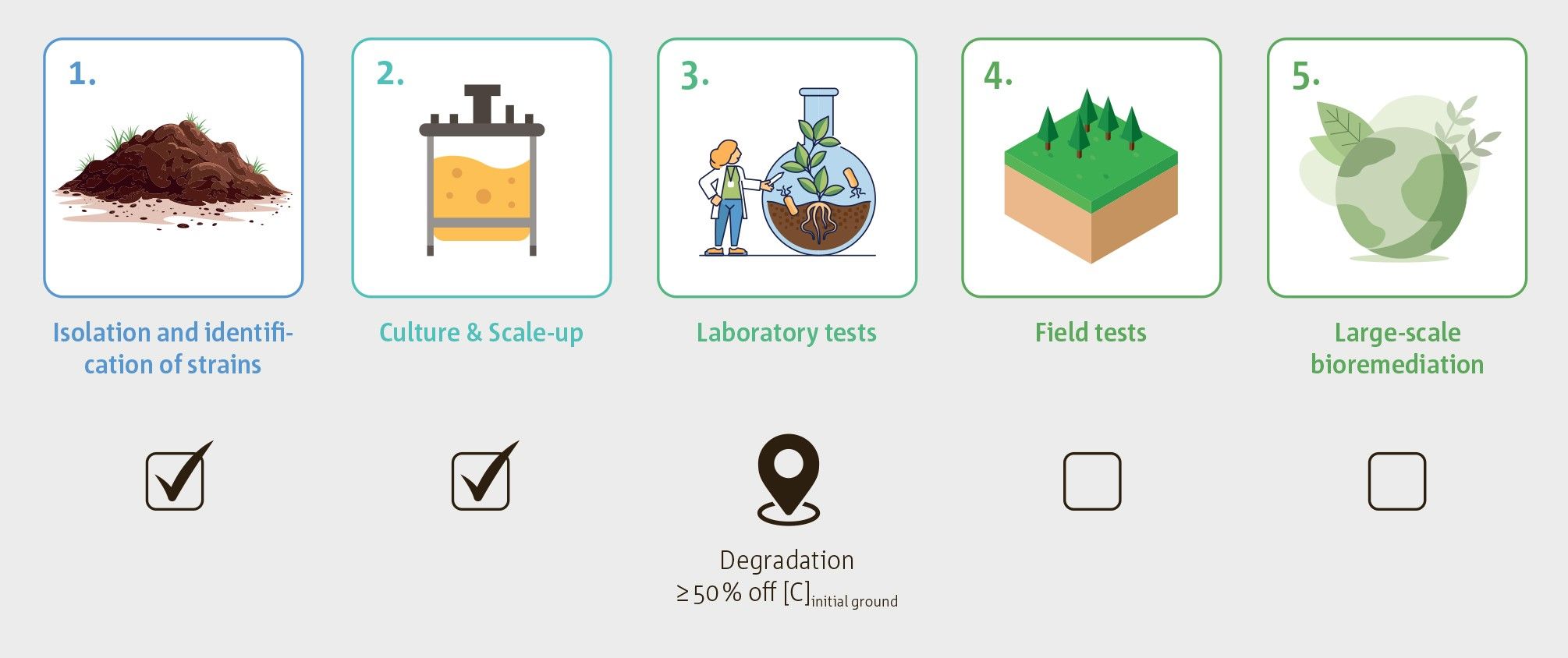
This project is a collaboration with TIBIO, a company engaged in environmental biotechnology and scientific consulting. It is divided into five stages (see Figure below), starting with small-scale laboratory experiments and getting closer to the real world conditions of use at each new stage. The first stage consists of finding micro-organisms able to degrade the explosives of interest. For this purpose, a site has been chosen as a potential source residues present in the soil. The site selected has also remained untouched for a long periode of time, so it is possible that local micro-organisms have learned to feed off the pollutants. Three soil samples were taken from the site. The micro-organisms able to survive in the presence of explosives were then isolated and identified. In the second stage the micro-organisms selected are cultivated in greater quantity to evaluate the costs of using the treatment mix on a large scale. If bio-remediation proves more expensive than remediation in situ, it would be difficult to justify its application. Bioremediation tests will then take place in the lab. That will be the moment to assess the effectiveness of biodegradation to confirm that the output from the degradation is not more toxic than the initial substances. If the initial concentration of pollutant is at least 50% degraded, the first tests will be carried out on a small plot of land. Finally, there will be full-scale bioremediation.
Conclusion and outlook
At the moment the project has just successfully completed the second stage, and the initial degradation tests in the laboratory should start in the next few months. However, each stage involves a host of challenges and obstacles that could block the project and send it back to the starting point.