

Focus on research: Annual reporting on research programme 4 «Impact, Protection and Safety»
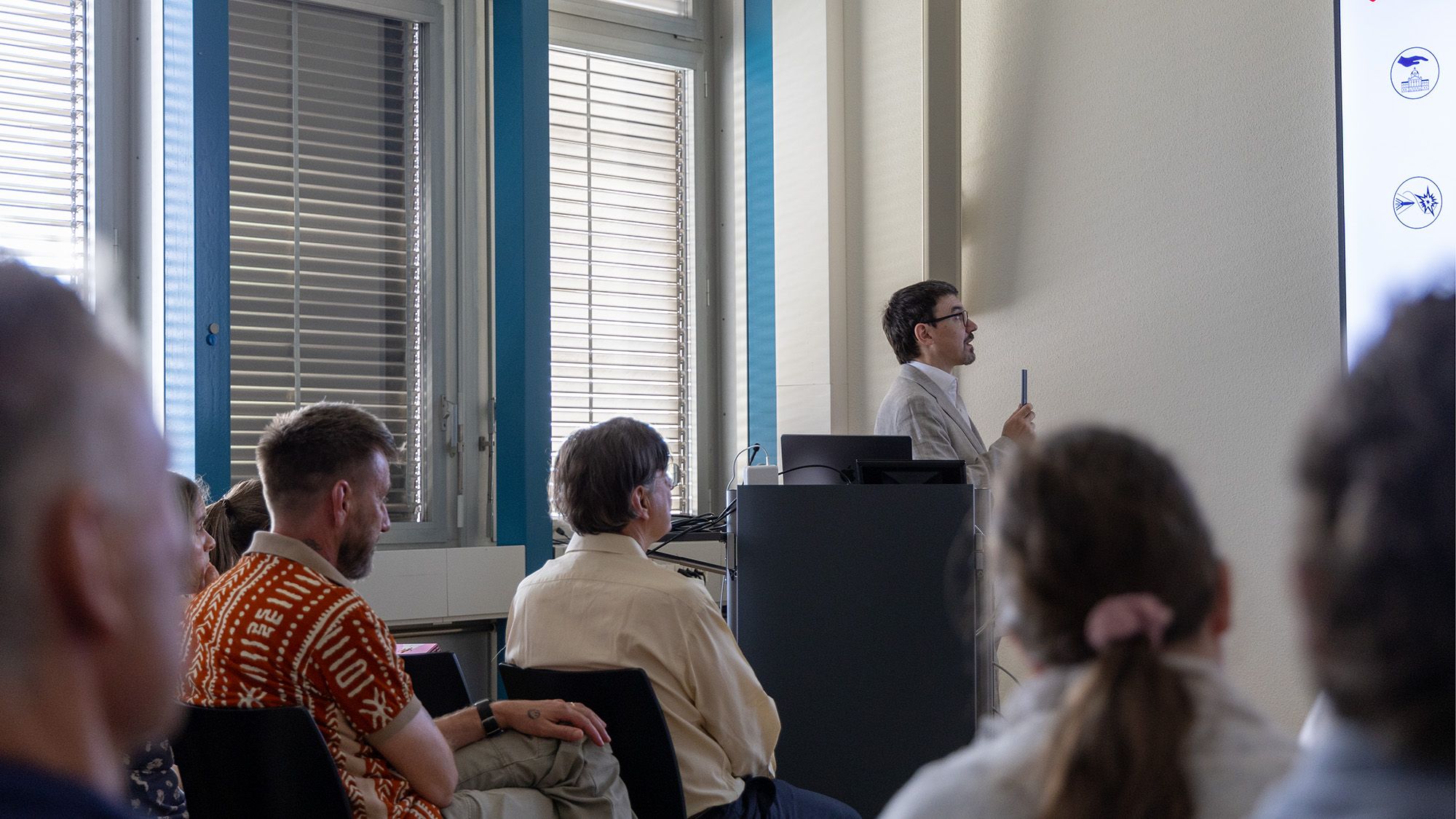
On Thursday, 12 June 2025, research programme director Dr Ronny Lorenzo welcomed internal DDPS employees to the annual research reporting event of the research programme Impact, Protection and Safety. Dr Ronny Lorenzo presented an overview of the research programme to an interested audience and provided fascinating insights into current research projects.
Moana Häfeli, Staff, armasuisse Science and Technology
In brief
The goal of the annual reporting events of armasuisse Science and Technology’s (S+T) research programmes is to grant interested internal employees at the DDPS a look behind the scenes of the research programmes. This framework not only offers broad insights into various different fields of work and ongoing projects, but also a useful opportunity for the open exchange of ideas. The event thus encourages the mutual exchange of knowledge and strengthens cooperation internally in the DDPS.
Dr Ronny Lorenzo, research programme director for Impact, Protection and Safety opened the annual reporting event on the research programme to around 60 attentive internal DDPS employees. At the start, the audience was given a brief introduction to the focal points of the research programme.
Here, Dr Ronny Lorenzo categorised the research programme Impact, Protection and Safety as follows “We are focusing on the last link in the chain”, thus underscoring the importance of the various research programmes. The research programme Impact, Protection and Safety only comes into play as a result of this successful groundwork. This is split up into four fields of competence: Impact, protection and safety of mobile objects, protection and safety of infrastructure as well as calculation models and simulation. In addition, a small part of the research programme deals with the environmental impact of the weapons used.
From threat to perception
The subsequent presentation dealt with the question: How can you react as successfully as possible to an enemy in the event of war? In addition to the success factors of resources and war economics, flexibility is an important component of this. A high degree of flexibility is key for the troops and applies in particular for the technologies used. However, in order to be able to ensure the adaptive capacity of the technologies, Dr Ronny Lorenzo demonstrated the high level of effort necessary just to provide the basic knowledge for this purpose. This was demonstrated to those present using three examples. On the one hand, basic knowledge in the area of personal protection is required. Where, for example, the impact of fired shots on equipment (helmet, protective vest) of a soldier is examined using photogrammetry. On the other hand, there is a need for expertise in the optimisation of weapons, for example, Explosive Form Projectiles (EFP). In this case, the composition of the EFP may vary to change the capability of the projectile or to save construction costs accordingly.
Fundamental knowledge is also required in the area of the impact of warheads, and involves correspondingly high costs. In particular, the compilation of the warhead and the accuracy of the weapon require a complete characterisation. The impact potential of the weapon can only be assessed in this manner. To this end, a large-scale trial was performed in 2019 with international participation in Sweden, as trials with large and very large quantities of explosives are not possible in Switzerland. The insights gained from this are incorporated, among other factors, in the construction and the renovation of new or existing protected facilities as well as in the understanding of the weapons systems.

Development of passive protective measures for Mitholz
Dr Lea Siegenthaler, project manager at armasuisse S+T in the specialist area Weapon Test Centre and Dr André Koch from the company Dynamic Phenomena completed the annual reporting with insights into the development of passive protective measures (PPM) to reduce the safety radii in Mitholz. The necessity of PPM to reduce the safety radii in Mitholz was identified by the DDPS innovation spaces. In this connection, the two speakers were tasked with the development of a specific proposal for solution. The aim of the task was to arrange the PPM such that the hazard zone around ignited ammunition, for example, can be considerably reduced. The solution approaches drawn up for this purpose had to meet the following protective requirements – protection from excess detonation pressure as well as protection from primary and secondary fragments.
In addition, a further challenge exists in using sufficiently available and easily usable material on site. This resulted in the use of a steel cylinder with a polyethylene (PE) tube which was filled with appropriate materials. In the ensuing development phases of the simulation, the parameter study, the experiments up to the trials in the field, various combinations of materials and filling quantities were tested. It was shown that in particular, the parameter study carried out using simulations is crucial for creating an optimum solution for the PSM. In conclusion, the trials in the field made it clear that no acceptable solution is yet available for larger explosives. Despite this, the basic concept developed provides an initial approach which can be built on in the future.
Conclusion and outlook
At this point, armasuisse Science and Technology took the opportunity to thank the speakers on behalf of all participants for the lively interest as well as the valuable, open, exchange of ideas.