

Multi-spectral camouflage modules from the 3D printer – a successful research project between Switzerland and Germany
As part of a research cooperation, armasuisse Science and Technology (S+T) has tested the possibilities of additive technologies for application in the multi-spectral camouflage area, together with other partners. The cooperation project and current research findings are presented in a video.
Lucas Ballerstedt and Sarah Trösch, Staff, competence sector Science and Technology
The international cooperation facilitates an overall picture of research results while at the same time promoting cooperation. The resulting exchange of knowledge reveals common challenges and possible solutions for them.
«We need new research strategies for camouflaging sensitive areas particularly well».
As part of a cooperative research project on production procedures in the area of multi-spectral camouflage, armasuisse Science and Technology (S+T) has entered into a cooperation with the Bundeswehr Technical Center for Protection and Special Technologies (WTD52), the Fraunhofer Institute for High Frequency Physics and Radar Techniques (FHR), the Bundeswehr Research Institute for Materials, Fuels and Lubricants (WIWeB) and the University of Bern.
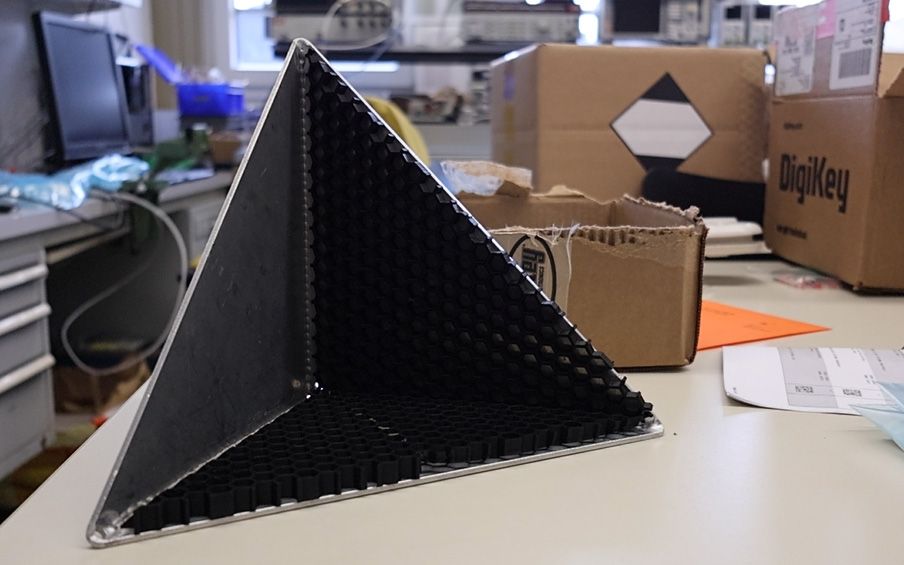
Among other things, the research partners have been focusing on how sensitive areas of vehicles can be camouflaged so that the vehicles are not discovered by thermal imaging cameras and radar devices. New production methods for printing camouflage modules have therefore been examined in a pilot project. The choice of suitable materials and printing of special 3D structures is particularly important in this procedure. The characteristics of the prototypes thus created were then examined. In a further step, the knowledge obtained will now be made available to Swiss and German industry.