

From Research to the Swiss Armed Forces: Annual Reports on the “Unmanned Systems / Robotics” and “Space” Research Programs
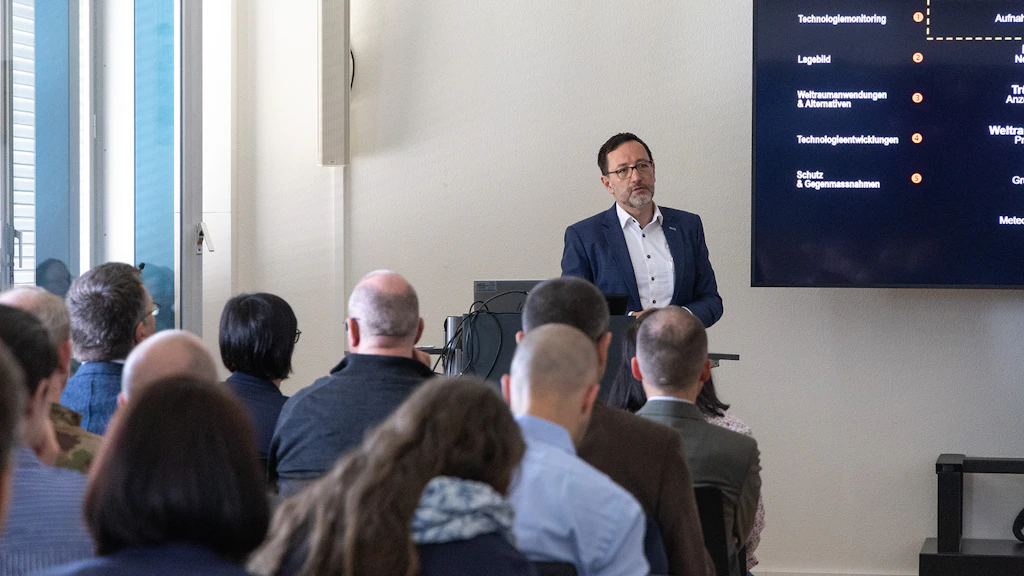
Wednesday, May 13, 2026, armasuisse Science and Technology (S+T) hosted the annual reporting sessions for the “Unmanned Systems / Robotics” and “Space” research programs. The research program directors, Dr. Markus Höpflinger and Dr. Peter Erni, provided insights into current research activities, projects, and results.
Leandra Kolb, Staff, armasuisse Science and Technology
In brief
The annual reports on the research programs of armasuisse Science and Technology (S+T) aim to give interested DDPS staff a behind-the-scenes look at the research programs. This format not only offers diverse insights into various fields of work and ongoing projects but also provides a good opportunity for open discussion. In this way, the event promotes the mutual exchange of knowledge and strengthens internal DDPS collaboration.
The research program directors welcomed approximately 100 interested attendees to the internal DDPS event held at the armasuisse S+T premises in Thun. This year’s research program reporting once again enjoyed a high level of interest from within the DDPS
Unmanned Systems and Robotics Research Program: Focus on Transfer
Dr. Markus Höpflinger, research programme director of “Unmanned systems/robotics”, opened the annual reporting session with a presentation on the current status of the research program. He began by briefly introducing the five areas of expertise that the research program covers (mobility concepts, navigation, humans, technology and the environment, key technologies, and future military applications). He emphasized that there is a particular focus on the area of expertise “future military applications” and that this will be adjusted over the course of the year. Consequently, he presented the research program’s main focus to the audience: transfer. The central focus is on transferring research findings to procurement and application within the Swiss Armed Forces. The goal is to advance research to the point where it influences industry and, consequently, procurement, thereby ensuring a successful transfer to the Armed Forces. The event ARCHE - Advanced Robotic Capabilities for Hazardous Environments, organized jointly with ETH Zurich and the Swiss Armed Forces, has been supporting this transfer for eight years.
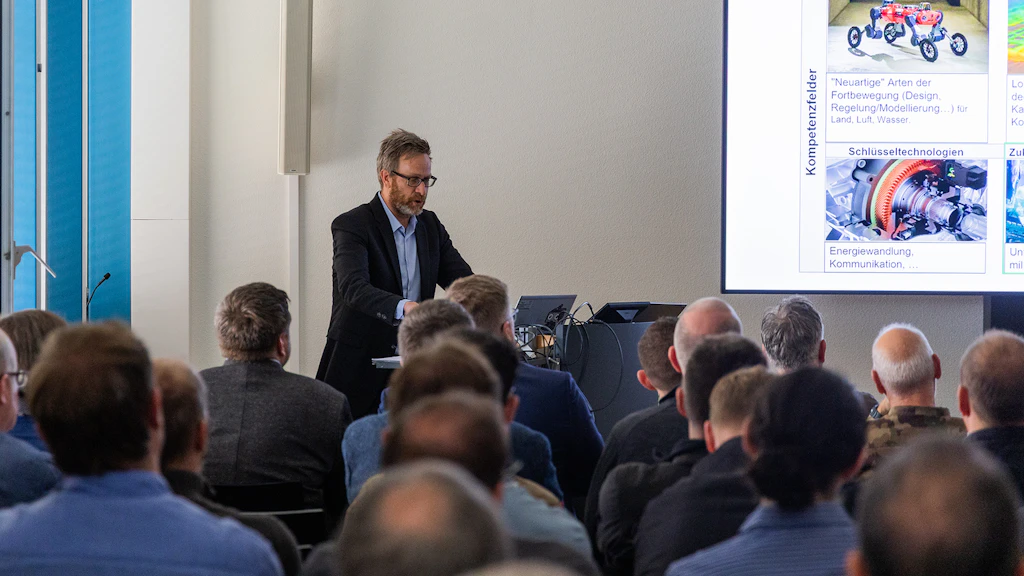
Dr. Markus Höpflinger also pointed out to the audience that in 2025, all five of the top robotics companies in the “Top 100 Swiss Startups” ranking have originated, directly or indirectly, from a collaboration with the Academy and the “Unmanned Systems and Robotics” research program. One example is the company Tethys Robotics, which successfully made the transition from the Academy all the way to procurement for the Army.
In the subsequent presentation, Dr. Samuel Huber of Forventis GmbH provided the audience with an insight into the field of human factors in robotics and counter-robotics. Among other things, Forventis GmbH investigates the comparison between humans and machines, how they interact with one another, and how humans can collaborate with machines. Samuel Huber also demonstrated that efficient human-machine collaboration requires an intuitive form of communication with machines and that, in the future, robots will be guided via task-based tactics.
Furthermore, Prof. Dr. Jan Skaloud from EPFL presented his research activities on the topic of “Positioning and Navigation in GNSS-degraded environments.” Prof. Dr. Jan Skaloud demonstrated how weak GPS satellite signals are on Earth and that visual drone navigation without GPS is too dependent on environmental conditions to be used in all situations. He then showed how positioning errors during GPS outages can be significantly reduced using a “Vehicle Dynamic Model” purely mathematically and without additional sensors.
After a break, Prof. Dr. Loris Roveda from the University of Applied Sciences and Arts of Southern Switzerland (SUPSI) opened the morning’s second session. In his presentation, he discussed new machine learning methods for manipulating objects with humanoid robots. In the following presentation, Prof. Dr. Robert Katzschmann from ETH Zurich provided insights into “Robotic Dexterous Manipulation and the Aerial Drone Project – Noctua.” He and his team are researching new mechanical designs for versatile hands and their control systems. The research focuses on conventional electromechanical systems as well as more novel artificial muscles. In the final presentation of the morning, Roland Raith and Alex Braun from Fotokite AG presented their company and its plans to utilize civilian drones for military applications. Fotokite develops tethered drones. This enables a continuous power supply from the ground station, resulting in unlimited flight times. Since data is also transmitted via the cable, radio reconnaissance and jamming are rendered impossible, and a consistently high data bandwidth is achieved.
Strategic Areas of Expertise and Operational Capabilities in Space
Dr. Peter Erni, research programme director Space, opened the afternoon session with a brief overview of the various presentations scheduled for the afternoon and how they address the areas of expertise of armasuisse S+T as well as the operational capabilities of the Swiss Armed Forces. armasuisse S+T conducts research in the space sector across six areas of expertise (technology monitoring, situational awareness, space applications and alternatives, technology developments, protection, and countermeasures).
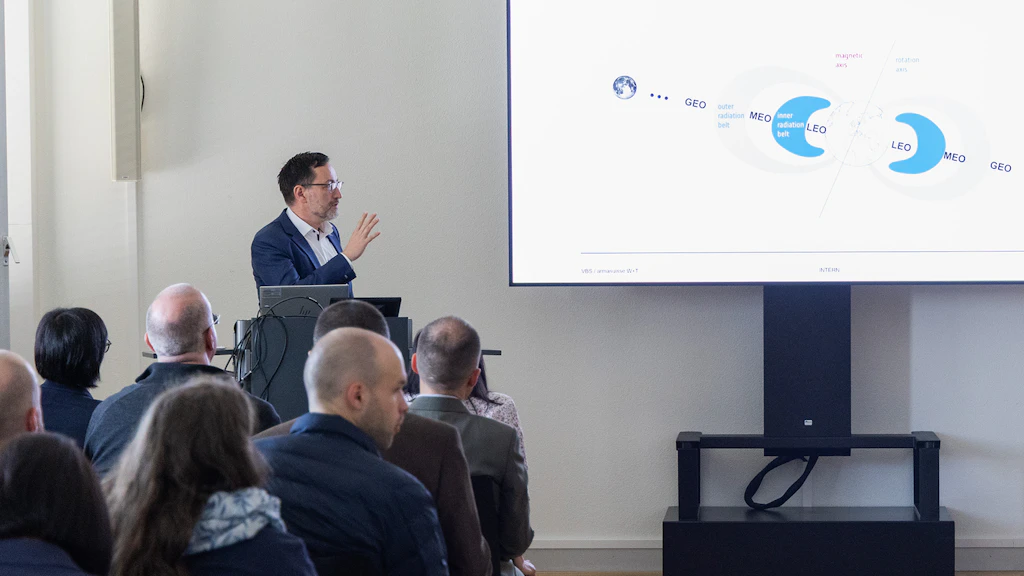
Over the next ten years, the Swiss Armed Forces aim to substantially build up their capabilities in the space domain. The goal is to establish five operational capabilities: creation of the space situational awareness picture (SSA/SDA), contributions to Earth observation (IMINT and ELINT), contributions to networked operations in the field of telecommunications (SATCOM), contributions to precision navigation (PNT), and active and passive defensive countermeasures (DCS).
In his presentation, Felix Seidel from ETH Zurich introduced the new ETH Swiss GeoLab in Lucerne, which focuses on Earth observation. The goal is to use data from space, the air, and the ground to develop solutions for specific challenges—ranging from the early detection of natural disasters to crop yield forecasts for agriculture.
Furthermore, the presentation by Prof. Dr. Christoph Wildfeuer from the University of Applied Sciences and Arts Northwestern Switzerland (FHNW) was entirely devoted to quantum communication. On behalf of armasuisse S+T, the FHNW conducted a strategic assessment of quantum communication technologies with a focus on their potential for secure and resilient communication networks, particularly for applications by the Swiss Armed Forces. It is a joint project of the research programs Communication, Cyberspace, and Space. The study lays the groundwork for future projects. One focus of the study was, among other things, quantum key distribution (QKD).
At the end of the day, Gunter Stober from the University of Bern provided insights into his research activities on meteors, noting that the University of Bern’s low-frequency radar, currently under development, can also be used for the detection of satellites for space surveillance. This is a joint program between the research programs Reconnaissance & Surveillance and Space.
Conclusion and Outlook
On behalf of everyone involved, armasuisse Science and Technology would like to take this opportunity to thank the speakers and express its appreciation for the keen interest shown and the open and valuable exchange of ideas among participants.